Why Your TikTok Videos Get No Views: 12 Reasons & How to Fix Them
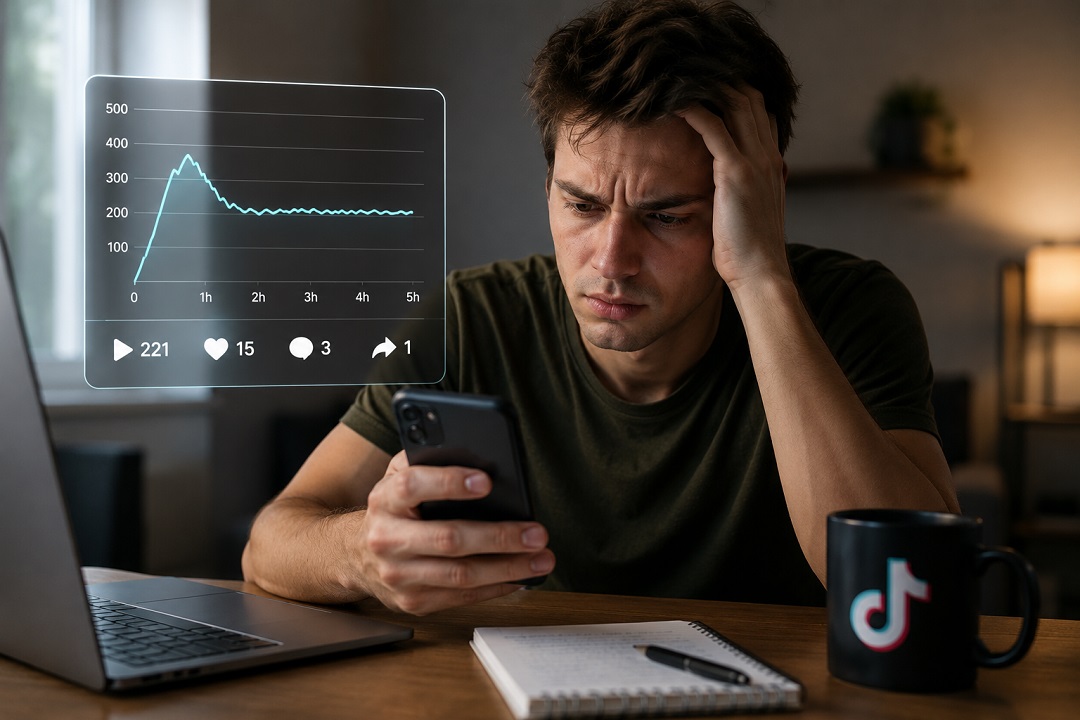
Your video is sitting at 200–300 views and going nowhere. That's not bad luck — TikTok has a specific logic for how it distributes content, and it's easier to break than most creators realize. The platform isn't burying your video on purpose: it received signals that the content isn't worth pushing further. Here are 12 real reasons why that happens, and exactly what to do about each one.
How TikTok Decides Who Sees Your Video
TikTok doesn't send your video to millions of people when you hit publish. According to creators and social media researchers, the platform first shows it to a limited test audience to measure initial response — TikTok has never officially disclosed the exact size of this group. It then watches how that audience behaves: do they watch to the end, scroll away in the first second, save it, share it, comment?
If the response is strong, the video moves to a larger wave. If not, distribution stops. That's why two videos from the same account can perform completely differently — everything comes down to how that first group reacts.
One significant change in 2026: TikTok now primarily shows new videos to your existing followers first, then measures how fast and strongly they engage. Videos that generate high engagement velocity from followers within the first 60 minutes are rewarded with broader distribution to non-followers. A small, highly engaged audience now gets content pushed further than a large, disengaged one.
Signals that most commonly drive distribution, according to practitioners:
- Completion rate — the percentage of viewers who watch the full video. By most accounts, this is the primary filter. A short video with a high completion rate will generally outperform a longer one with poor retention.
- Shares — the strongest signal that content is worth spreading beyond your current audience.
- Comments — especially replies and real conversations, not one-word reactions.
- Saves — content someone wants to return to later.
- Likes — the weakest signal of the five, per practitioner observations.
One thing many creators miss: TikTok counts watch depth, not just views. A video with a 60% completion rate often gets further distribution than one with a higher view count but 20% retention. Depth of engagement matters more than raw numbers.
Technical Reasons: When the Problem Isn't the Content
Reason 1. Community Guidelines Violation
TikTok automatically scans every video for violations: unlicensed audio, potentially harmful content, misleading claims. If the system flags your video, it may be removed — or silently restricted without any notification. Your account keeps working, you can still upload, but your reach disappears.
How to check: go into analytics for a specific video → "Traffic source types." If the share coming from "For You" is near zero, that's a warning sign.
Reason 2. Copyright Issues
Using someone else's music, video clips, or other content without proper rights is one of the most common causes of restricted reach. TikTok's Content ID system automatically limits distribution of videos with detected violations. The video may stay up — it just stops appearing in the For You feed.
Fix: use tracks from TikTok's built-in Sound Library, or verify your license allows the specific use.
Reason 3. Shadowban
Many creators use the term "shadowban" to describe a sudden drop in reach — videos stop appearing in the For You feed without any warning or deletion. TikTok officially doesn't confirm this mechanism exists, but the pattern is consistent across thousands of creator reports.
Signs your account may be restricted:
- New videos get significantly fewer views than usual
- The "For You" traffic source drops to near zero in analytics
- Your videos don't appear when you search your own hashtags from another account
Possible causes cited by creators: sudden spikes in activity, flagged hashtags, user reports, rule violations in comments. Per creator observations, these restrictions often lift within a few weeks — but there are no official timelines.
Reason 4. Reposting and Duplicate Content
TikTok actively discourages reposting content — especially videos downloaded from other platforms with watermarks. The platform has stated it doesn't promote watermarked content. Uploading the same video multiple times, or content that closely mirrors existing videos, can also trigger distribution limits.
Reason 5. Poor Technical Quality
TikTok recommends high-quality video and clear audio. Videos with obvious technical issues — blurry footage, noisy audio, very low resolution — tend to receive lower initial distribution. This doesn't require professional equipment, but the basics matter.
Content Reasons: When the Video Itself Is the Problem
Reason 6. A Weak First Three Seconds
The "200-view jail" is a common phenomenon where videos stop gaining reach after the initial test batch. This usually happens because the video failed to generate enough engagement or had a low completion rate. And almost all of that is determined by the first three seconds.
Swiping away in the opening moments is one of the strongest negative signals the algorithm receives. If most of your test audience leaves immediately, distribution stops after the first wave.
Common mistake: starting with a logo animation, silence, a title card, or "Hey guys, welcome back." The first frame should answer: why should I keep watching this?
Reason 7. Low Completion Rate
If viewers watch the first few seconds and leave, the algorithm reads it as a mismatch between what the thumbnail/caption promised and what the video delivers — or simply content that doesn't hold attention.
What helps: loops (where the end of the video flows back into the beginning, prompting a rewatch), mid-video questions that make viewers want to stay, information people want to capture or save. Keep in mind that completion rate benchmarks vary significantly by video length — what counts as strong for a 10-second clip is different from a 2-minute video.
Reason 8. No Clear Niche
TikTok's algorithm creates interest clusters from what a user watches, skips, or engages with, and then matches new content to those clusters in real time. If your account posts about five different topics, the platform struggles to build a consistent audience cluster for your content.
In practice: a creator posting ten varied videos across five topics gets 500 views each, and no niche forms. The same creator posting three videos on one theme in a row often sees reach start to climb — because the algorithm finally has enough signal to know who to show it to.
Account-Level Reasons
Reason 9. New Account With No History
Many creators notice that new accounts get elevated attention from the algorithm on their first few videos — the platform seems to be figuring out the niche and potential audience. If those first videos underperform, later videos may start with lower initial reach.
What this means practically: your first uploads should be your most polished work, not test content. If organic traction is slow to build, an initial views boost can help clear the first distribution filter and get the video in front of the right audience. smmtools.top has TikTok Views and TikTok Auto Services — no account access required.
Reason 10. Posting at the Wrong Time
A common mistake: posting when it's convenient for you, not when your audience is online. If most of your viewers are in New York and you post at 3am EST, your first wave will be weak — and without strong initial signals, the video doesn't advance.
TikTok Analytics shows your followers' active hours under the "Followers" tab. Use those times, not generic "best time to post" lists from the internet.
Reason 11. Spammy or Irrelevant Hashtags
Hashtags play a minimal role in TikTok's 2026 algorithm. The system analyzes video content directly using computer vision and NLP — it understands what your video is about without hashtag hints.
#fyp and #foryoupage do not help you land on the For You Page. This is one of the most persistent myths on the platform. What practitioners observe works: three to five specific hashtags that accurately describe the content. A stack of twenty random tags often reads as spam.
Reason 12. Too Many Weak Videos
Posting low-quality content just to hit a quota can hurt performance. Quality tends to matter more than volume. One video with strong retention often does more for an account than ten average ones published daily. Frequent posting of weak content builds a history of poor interactions — which the algorithm takes into account when deciding how much reach to extend to your next video.
How to Diagnose the Problem: Step by Step
Before changing anything, figure out where the issue actually is.
- Open TikTok Analytics (Profile → Creator tools → Analytics) — look at the last 28 days minimum.
- Check traffic sources for individual videos. Low "For You" share = problem with first impressions.
- Review audience retention in video analytics. Dropping off in the first seconds = work on the hook. Dropping off in the middle = work on the content structure.
- Test for restrictions: log into a second account, search your video by hashtag or keyword. If it doesn't appear, there may be a reach limitation.
- Compare your last five videos: if all show similar underperformance — the issue is account-level or niche-related. If one video outperforms the others — the issue is the content of the rest.
If you want to give a specific video a push right now — try TikTok Views on smmtools.top. First results typically show within a few hours.
Common Myths & Mistakes
Myth: #fyp and #foryou get you on the For You Page. The For You Page is algorithmic — it's not connected to any hashtag. Adding #fyp doesn't affect distribution. TikTok has confirmed this in creator Q&As.
Mistake: Deleting videos with low views. The algorithm occasionally revisits older videos and starts distributing them days later. Deleting content removes that possibility. Better to leave the video, learn from the analytics, and improve on the next one.
Mistake: Posting whenever it's convenient. Posting time affects the quality of your first-wave audience. Check your follower activity data in TikTok Analytics and post 30–60 minutes before your peak hours.
Myth: More videos always means more growth. Volume without quality tends to build a poor engagement history. Per creator observations, posting less but better usually outperforms a daily upload schedule of inconsistent content.
FAQ
Q: Why does my TikTok video stop at 200 views? A: Per creator observations, the initial test batch is typically a few hundred viewers — TikTok hasn't disclosed the exact number. If that group doesn't provide enough signals (completions, shares, saves, comments), distribution stops there. To move past it, you need a solid completion rate and at least one strong engagement action: a share, a save, or a comment thread.
Q: What is a TikTok shadowban and how long does it last? A: "Shadowban" is the term creators use for a sudden reach drop where videos stop appearing in the For You feed — without deletion, without notification. TikTok officially doesn't confirm this mechanism. Based on creator reports, restrictions often lift within a few weeks, though there are no official timeframes. Common recovery approach: stop any potential violations, reduce activity for a few days, then resume posting gradually.
Q: Does posting time affect TikTok views? A: Yes, indirectly. Posting time determines who from your audience sees the video first. Strong early engagement from that initial group signals the algorithm to push it wider. Check the "Followers" section in TikTok Analytics for your specific peak activity hours — they differ by account and audience location.
Q: Why does a new TikTok account sometimes get more views than an established one? A: Many creators observe that new accounts receive elevated algorithmic attention on their first uploads while the platform learns the niche and audience. If an older account's views have dropped, it may have accumulated a history of weak interactions, received a reach restriction, or lost niche clarity from inconsistent content.
Q: How do I know if my video has a reach restriction? A: Open video analytics → Traffic source types. If "For You" is near zero and "Followers" or "Profile" are your main sources, the video isn't being distributed to new audiences. Secondary check: search your video by hashtag from a second account. If it doesn't appear, there's likely a restriction in place.
Q: Should I delete TikTok videos with low views? A: No. The algorithm occasionally returns to older videos and begins distributing them days after upload. The better approach: leave it, analyze why it underperformed, apply those lessons to the next video.
Q: How many hashtags should I use on TikTok? A: Based on practitioner observations, three to five topically relevant hashtags work best. Large stacks of unrelated tags are often treated as spam signals. The platform's own content analysis — not hashtags — is the primary way TikTok understands what your video is about.
Conclusion
TikTok doesn't hide your videos. It distributes the ones that generate the right signals from the right viewers early on: completions, shares, saves. Likes and upload frequency are at the bottom of the priority list.
The core insight: most reach problems come down to the first three seconds and niche consistency — not posting volume. One video that holds attention to the end will typically do more for your account than ten average ones per week.
If your organic reach is building slowly, an initial views boost helps clear the first algorithmic filter and gets your video in front of the audience it's meant for. You can start here: TikTok Views on smmtools.top.

