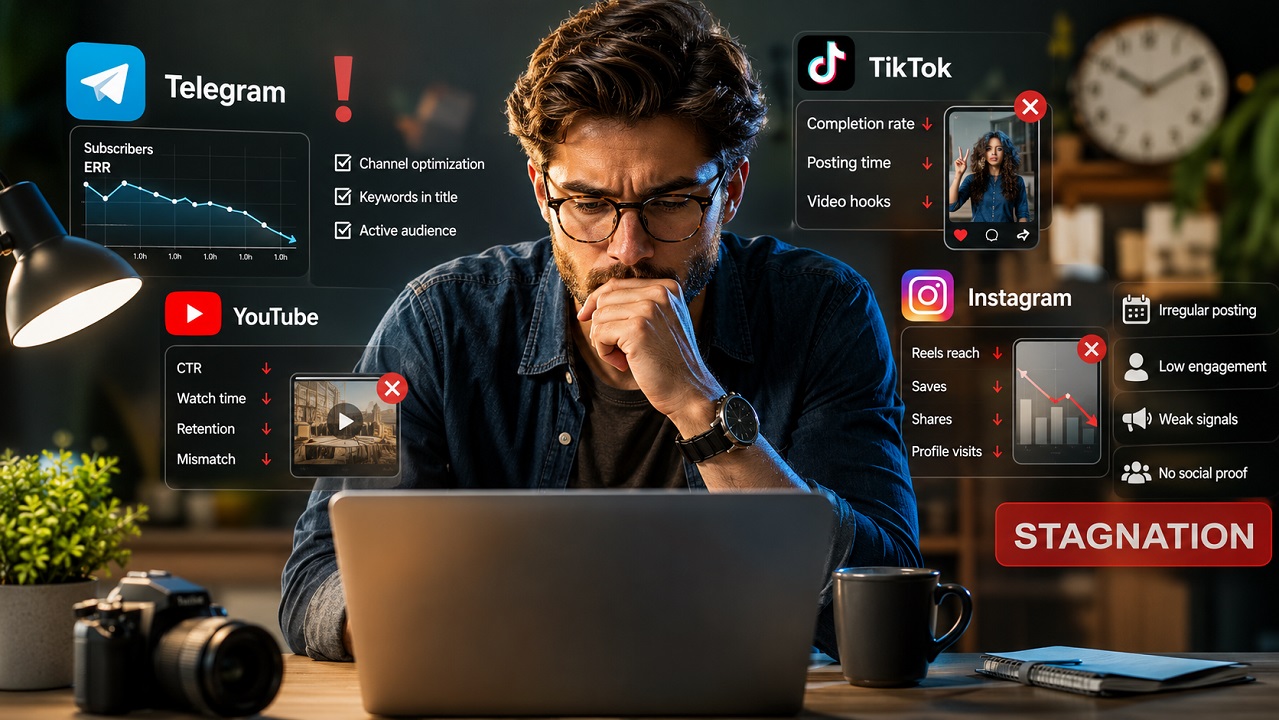
Why Followers Won't Grow: 11 Mistakes, Platform by Platform
If growth has stalled on Telegram, YouTube, TikTok, or Instagram, the content is rarely the actual problem. Something more specific gave out: the ratio of views to followers dropped, posting got patchy, or a platform-specific cue quietly disappeared. Below are 11 mistakes behind stalled growth, split out by platform, with a 10-minute checklist at the end to find yours.
General reasons growth stalls, across every platform
Every platform has a rough point where its algorithm starts pushing content past an existing audience on its own — call it the social proof threshold. Below that point, growth is slow and mostly manual. Cross it, and growth speeds up, because content starts reaching people who've never seen the account before.
The common reason accounts stall anywhere is the same: engagement (views, likes, shares, comments) drops relative to audience size. All four platforms weigh that ratio heavily. When it falls, the system gradually stops pushing content past current followers.
What actually counts as engagement
What an algorithm sees after a post goes up: watch-through, shares, saves, comments, profile visits. Likes used to be the number everyone watched. Instagram hasn't said outright that shares now outrank likes — but going by how practitioners read their own results after 2026 platform updates, shares, saves, and profile visits seem to carry more weight in practice than a plain like.
Why a short boost sometimes turns things around
Mistake #1. Watching total followers instead of the ratio between views and followers. A channel with 10,000 followers and weak engagement usually reaches fewer people than one with 3,000 followers and strong engagement. That holds across all four platforms.
Mistake #2. Posting on no fixed schedule. A channel that drops five posts one day and goes dark for two weeks is harder for an algorithm to read, and an erratic schedule often tracks with lower priority in recommendations. No platform publishes the exact weight of this, but all of them bring up consistency in their own creator guidance.
A short activity boost — views, reactions — sometimes shifts stalled growth. The likely reason: fresh data gives the algorithm something new to work with, not some trick played on the system. No platform confirms this officially. Treat it as a working theory.
Telegram
Two things trip up most Telegram channels: low ERR (the share of an actually active audience), and a channel that's invisible in search. Telegram doesn't publish how its search ranks results, so everything below is drawn from channel owners' own observations and analytics platforms like TGStat and Telemetr, not from Telegram itself.
Mistake #3. Chasing subscriber count while ERR sits ignored. Analysts and channel owners often link high ERR to better visibility, in search and in other channels' recommendations. Telegram doesn't confirm that connection. In practice, 3,000 genuinely engaged followers frequently beat 10,000 inactive ones.
Mistake #4. Never setting up the channel for search: no keywords in the name, the description, the pinned posts. Telegram confirms two things — public channels turn up in its built-in search, and their content can get indexed by outside search engines. How results actually get ranked, Telegram doesn't explain. The conclusion many channel owners reach, watching their own traffic, is that a name and description without niche keywords pulls less organic search traffic. That's their read, not Telegram's. Full breakdown: How Telegram Search Works & Why Nobody Finds Your Channel.
Telegram shipped a major update on July 14, 2026 — a long-post editor, tables, community support. It changes the format people can publish in. It doesn't change the setup mistakes above.
YouTube
Two problems come up again and again: nobody clicks the thumbnail, or people click and bail because the video doesn't match what it promised. YouTube's own guidance ties recommendations to what viewers watch and skip, how long they stay, their likes and dislikes, and satisfaction surveys, and it tells creators directly to keep titles, descriptions, and thumbnails honest about the content.
Mistake #5. Stretching video length past what retention supports. A long video that holds a high completion percentage gets extra reach, by most creator accounts. A long video that loses people early does worse than a short one that holds attention.
Mistake #6. A thumbnail that oversells the video. YouTube's guidance is explicit about this one: keep the thumbnail and title accurate to the content. Channels that drift toward clickbait tend to lose ground in recommendations over time.
Early engagement helps. A video goes to a small group first, and how they respond shapes what happens next. That's not the same as saying the first few minutes decide everything — per YouTube's own materials, evaluation keeps running for hours afterward, as new watch-and-skip data comes in.
TikTok
TikTok punishes two things hardest: a completion rate that's dropped, and posting when a specific audience is offline rather than during some generic "prime time." TikTok's own materials point to user interactions, video information, and device settings as the basis for recommendations; creator guidance separately calls out watch-through and rewatches as strong interest signals.
Mistake #7. A weak hook in the first few seconds. Unofficial creator reports describe a new video getting tested on a small audience first, and some of those reports say that group leans toward existing followers — TikTok has never confirmed that mix. What holds up across the reports either way: whether that small group keeps watching decides if the video goes further, and a weak opening is the most common reason it doesn't.
Mistake #8. Posting without checking when the target audience is actually online. Creators report that posting while an audience is asleep tends to produce a slow start and a weaker overall run. TikTok has never published the mechanics of that first test push, so this stays a pattern, not a rule.
Full breakdown of low TikTok views, technical and content causes both: Why TikTok Videos Get No Views: 12 Reasons & Fixes.
Instagram in 2026 punishes a mismatch between what a creator actually posts and what the platform's Your Algorithm feature has already tied to their audience. On top of that, plenty of creators are still chasing likes over shares and saves.
Mistake #9. Posting across unrelated topics from one account. Instagram's Your Algorithm feature is officially confirmed live across Feed, Reels, and Explore, with an update posted April 15, 2026 — users can now fine-tune the topics they want to see in all three. Content that jumps between unrelated topics makes it harder for the algorithm to match it to the right audience, and reach drops even when production quality stays consistent.
Mistake #10. Chasing likes over shares and saves. Instagram hasn't said outright that shares now outrank likes. What creators tend to conclude, watching their own numbers, is that a share — sending a post via DM or to a Story — carries more weight than it used to: it takes a decision to send something to a specific person, where a like is just a tap while scrolling past.
Broader breakdown of what works on Instagram after the recent changes: How to Grow Instagram in 2026: What Actually Works.
The mistake almost everyone skips
Mistake #11. Treating a platform's own search bar as an afterthought — TikTok search, Instagram search (name, bio, alt text), Telegram search. Most effort goes into the recommendation feed, while a real share of new viewers arriving through in-platform search gets ignored entirely.
Diagnose your channel in 10 minutes
Answer yes or no:
- Has the views-to-follower ratio dropped this month compared to last?
- Posting consistently, no gaps longer than a week?
- TikTok — is completion rate at or above what past hits have shown?
- YouTube — is thumbnail CTR stable, and does content match what the title promises?
- Instagram — does recent content match the topic that was working when growth was better?
- Telegram — is ERR trending up or down over the past 2–4 weeks?
Two or more "no" or "declining" answers usually point to the main cause.
What comes next: change one variable at a time. Fix profile setup, posting schedule, and content format together, and there's no way to know which change actually worked. Make one change, give it 1–2 weeks before judging results — TikTok tends to show effects faster; Telegram and Instagram take longer — then move to the next item on the list.
When the content isn't the problem
Sometimes the content is genuinely good and growth still stalls, because the account hasn't crossed the threshold where an algorithm starts confidently pushing it past its current audience. Nobody publishes an exact number for where that line sits. The pattern practitioners notice: the fewer engagement signals an account has built up, the more cautious the algorithm stays about promoting it. A short boost in views, followers, or reactions can help cross that line faster. After that, if the content actually holds attention, growth can keep going on its own.
What's confirmed, and what's still a theory
Confirmed, straight from each platform: all four factor in audience behavior — what people watch, what they skip, how long they stay, what they share — as part of ranking. Instagram has confirmed Your Algorithm is live across Feed, Reels, and Explore, updated April 15, 2026. Telegram announced a major update on July 14, 2026: a long-post editor, tables, community support. YouTube ties recommendations to watched and skipped content, watch time, viewer reactions, and satisfaction surveys, and tells creators to keep titles, descriptions, and thumbnails accurate.
Probably true, not officially confirmed: specific thresholds — what ERR percentage or completion rate counts as "low" — come from practitioners and analytics platforms, not from published platform numbers. Same goes for the boost-as-reset idea, and for exactly who ends up in TikTok's first test audience.
Genuinely unknown: how much weight any single signal carries in a platform's ranking formula, or how that weight has shifted over time. None of the four platforms publish the full formula. What they publish is direction, not the math behind it.
FAQ
- How long before the algorithm notices a strategy change? On TikTok, a stronger hook or similar tweak often shows up in the next few posts. YouTube and Instagram usually take 1–2 weeks of consistent posting before a channel gets a fresh look. Telegram moves slowest — ERR changes can take weeks to show up in visibility.
- Can boosting views or followers backfire? A sudden, unnatural spike with no follow-up engagement sometimes reads as an anomaly to a platform. Treating a boost as a supplement to steady posting is safer than a one-off push with no strategy behind it.
- Follower count or engagement — which matters more? Across all four platforms, engagement (ERR, completion rate, shares) tends to drive reach more than raw follower count. A smaller, active audience usually outgrows a bigger, quiet one.
- Worth changing content format if growth has stalled? Not first. Run the checklist above and find which specific thing slipped — setup, schedule, or a platform metric. Changing format comes last, not first.
- Same checklist for a personal account and a business one? The basics hold either way: engagement relative to audience size, steady posting, content that matches what it promises. Priorities differ — business accounts lean on search and Reels/Shorts to reach new people; creators lean more on deepening ties with who's already there.
Bottom line
Stalled growth is almost never "the content got worse." More often it's one specific thing that slipped: engagement relative to audience size, an inconsistent schedule, or something platform-specific — ERR on Telegram, completion rate on TikTok, CTR and satisfaction on YouTube, topic clarity on Instagram. The checklist above finds what actually broke before a full strategy rework.
Want to cross that social proof threshold faster? smmtools.top has tools for that: smmtools.top/services.

